The tax regime for micro-enterprise income tax
Micro-enterprise income tax in Romania: eligibility conditions, rates, when you leave the regime, filing and payment, with practical examples.
1. Definition and eligibility conditions
A micro-enterprise is a Romanian legal entity that, under Title III of the Fiscal Code, must meet all of the following conditions on 31 December of the previous fiscal year:
- It earned income of no more than the equivalent of 500,000 euro (calculated at the National Bank of Romania exchange rate at the end of the financial year);
- The share capital is held by individuals or legal entities other than the state or administrative-territorial units;
- It is not in dissolution followed by liquidation;
- It earned income from activities other than consulting and/or management (exception: tax consulting, CAEN code (activity code) 6920, if its share is below 80% of total income);
- It has at least one employee (except in the situations set by art. 48 para. (3) of the Fiscal Code);
- The shareholders do not hold, directly or indirectly, more than 25% of the value of the participation titles in other micro-enterprises.
2. Choosing micro-enterprise income tax
Newly set up legal entities can choose to apply the micro-enterprise tax regime if they meet the conditions set by law. The choice is made at tax registration, by filing the statement of changes (Form 700).
3. Tax rates
- 1% for micro-enterprises that earn income below 60,000 euro and do not carry out specific activities (listed below);
- 3% for micro-enterprises that:
- Go over the 60,000 euro cap;
- Carry out activities in IT (software), legal, medical, HoReCa, restaurants, catering, bars and other food service activities.
4. Rules for leaving the regime
Micro-enterprises leave the micro-enterprise income tax regime if they:
- Go over the 500,000 euro cap;
- Earn more than 20% of their total income from consulting and/or management;
- No longer meet the condition of having at least one employee;
- Do not file the annual financial statements by the legal deadline.
Leaving the regime is final and must be communicated to the tax authority within 15 days by filing the statement of changes (Form 700).
5. Declaring and paying the tax
- Micro-enterprise income tax is calculated quarterly and paid by the 25th of the month after each quarter (for the fourth quarter the deadline is 25 June).
- Form 100 is filed for the tax due.
6. Additional points
- Sponsorships and private scholarships are no longer deductible from the tax from 2024, but you can ask for the tax to be redirected until 27 December through Form 177.
- Purchases of fiscal cash registers are no longer deductible from the tax.
7. Practical examples
Example 1: Micro-enterprise with ordinary activity
A company that makes textiles, with one employee and annual income of 280,000 RON, will pay:
- Q1: 65,000 RON x 1% = 650 RON
- Q2: 75,000 RON x 1% = 750 RON
- Q3: 60,000 RON x 1% = 600 RON
- Q4: 80,000 RON x 1% = 800 RON Total annual tax: 2,800 RON
Example 2: Micro-enterprise with mixed activity
A company that does catering (CAEN 5621), with annual income of 290,000 RON, moves from 1% to 3% in Q2:
- Q1: 65,000 RON x 1% = 650 RON
- Q2: 70,000 RON x 3% = 2,100 RON
- Q3: 85,000 RON x 3% = 2,550 RON
- Q4: 70,000 RON x 1% = 700 RON (back to 1%) Total annual tax: 6,000 RON
8. Legal basis
- Law no. 227/2015 on the Fiscal Code
- Government Emergency Ordinance no. 115/2023 on fiscal consolidation
- Government Emergency Ordinance no. 31/2024 on tax changes
- Government Decision no. 1393/2024 on the methodological norms
- ANAF Order no. 1699/2021 on the tax registration forms
Need help?
Leave us a number and an accountant will call you.
Thank you!
We got your details. We'll call you.
How eConta helps with dividends
Related articles
-
 Money and dividends
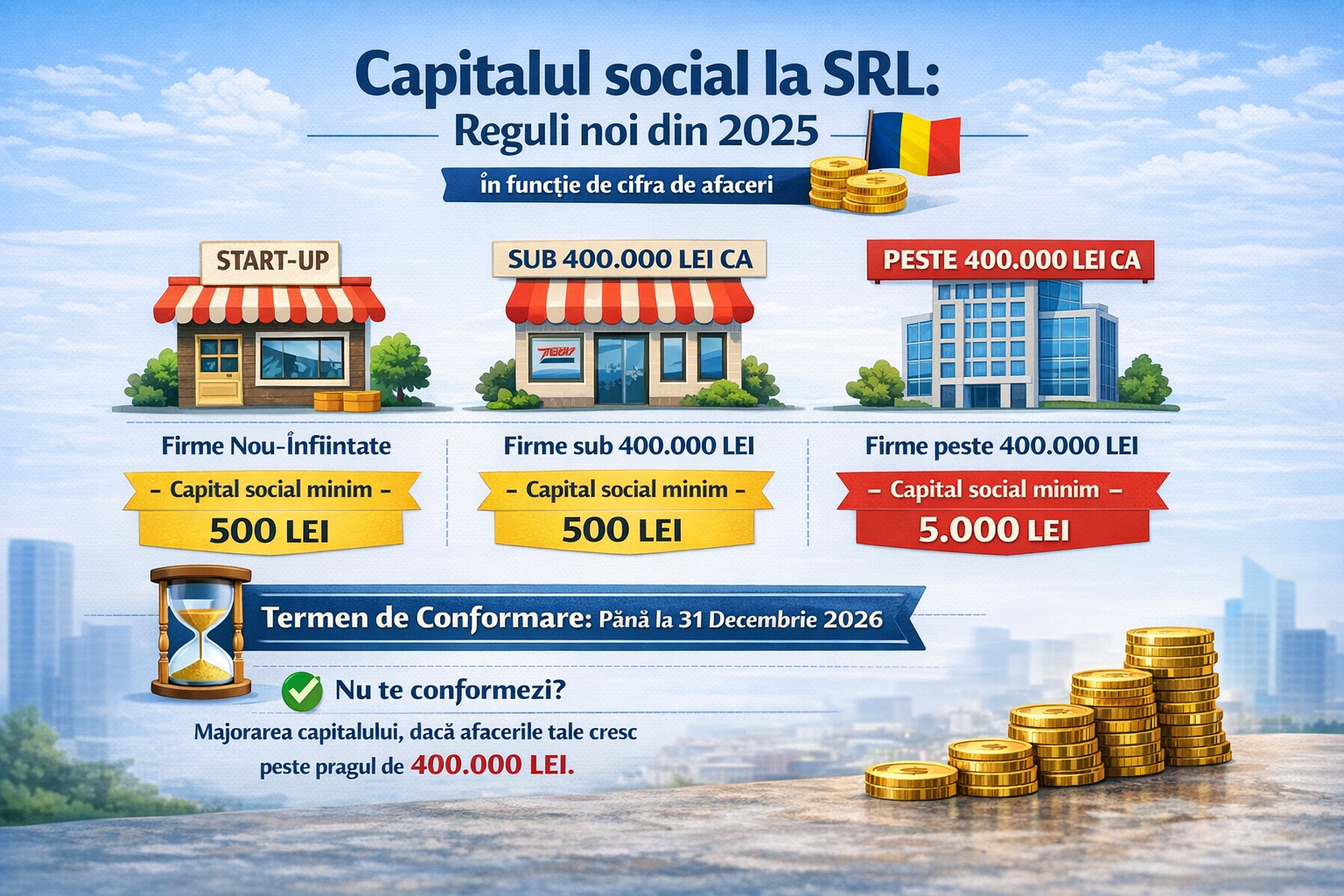
Law 239/2025: share capital, dividends and loans to shareholders
A practical summary of Law 239/2025: minimum share capital by turnover and…
Updated: 11 March 2026 · 4 min read -
 Company setup
How to set up an SRL in Romania in 2026: a complete step-by-step guide
You fill in a form, the rest is simple.
Updated: 5 June 2026 · 16 min read -
 Tax and ANAF
SAF-T (Form D406) return: a legal obligation and a responsible approach
At eConta, SAF-T costs 15 €, and the checking is included. Your peace of mind too.
Updated: 9 July 2025 · 5 min read