











Invoice to a foreign client without VAT: what to write on it and what to file
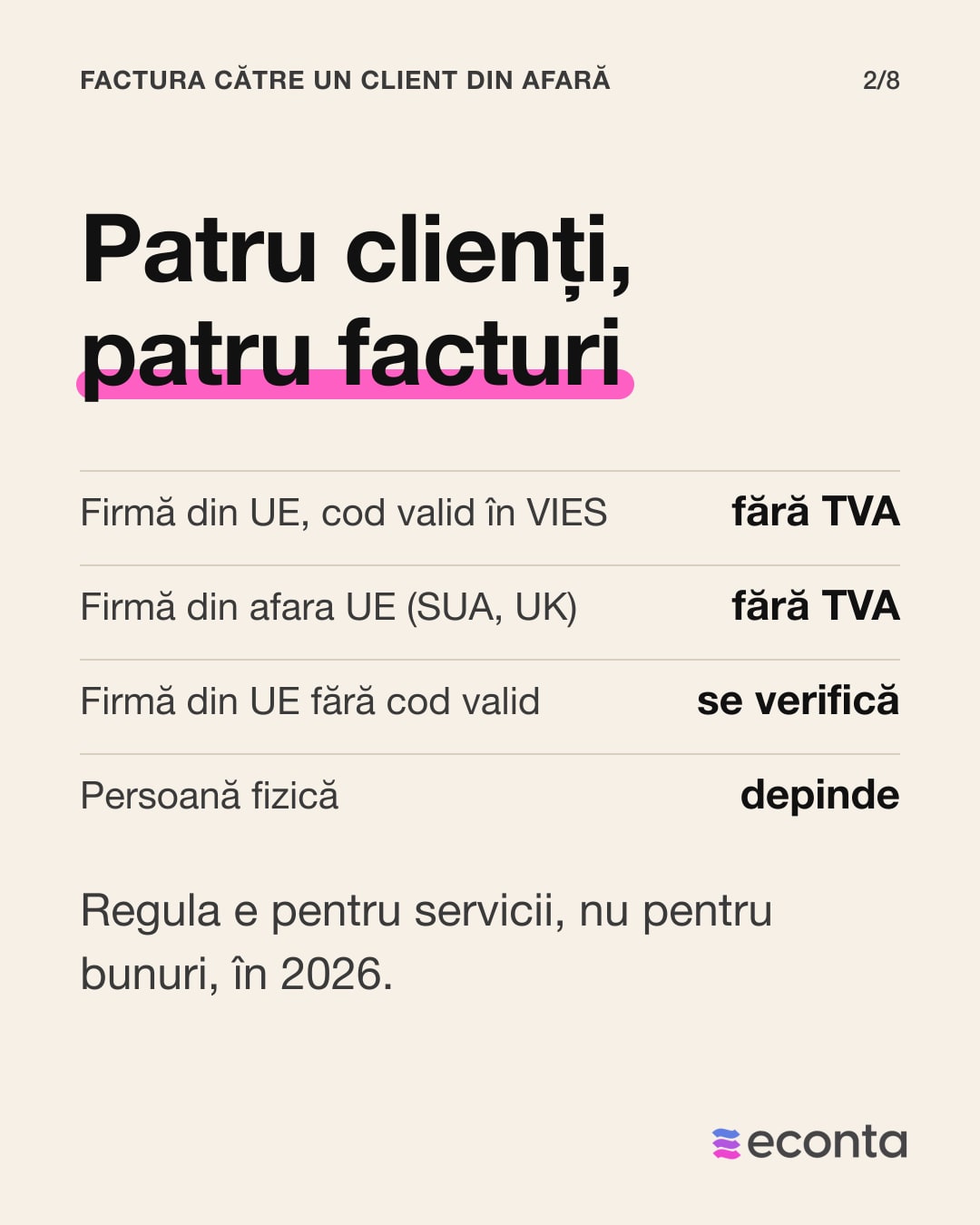
Four cases, four invoices: an EU company with a valid VIES number, an EU company without one, a non-EU company and a private individual, with the return that follows each.

What to remember
- An invoice for services to a foreign client is issued without Romanian VAT when the client is an EU company with a valid VIES number or a company outside the EU (the rule in the Fiscal Code, applied in 2026).
- To an EU company you write "reverse charge" ("taxare inversă") and the VAT numbers of both companies on the invoice. The next month you file Form 390 by the 25th.
- Not VAT-registered? Ask for the special VAT number (art. 317 of the Fiscal Code) before your first invoice to an EU company, however small the amount.
- To private individuals the rule changes with the service and the country. Electronic services sold in the EU above 10,000 € a year go through OSS.
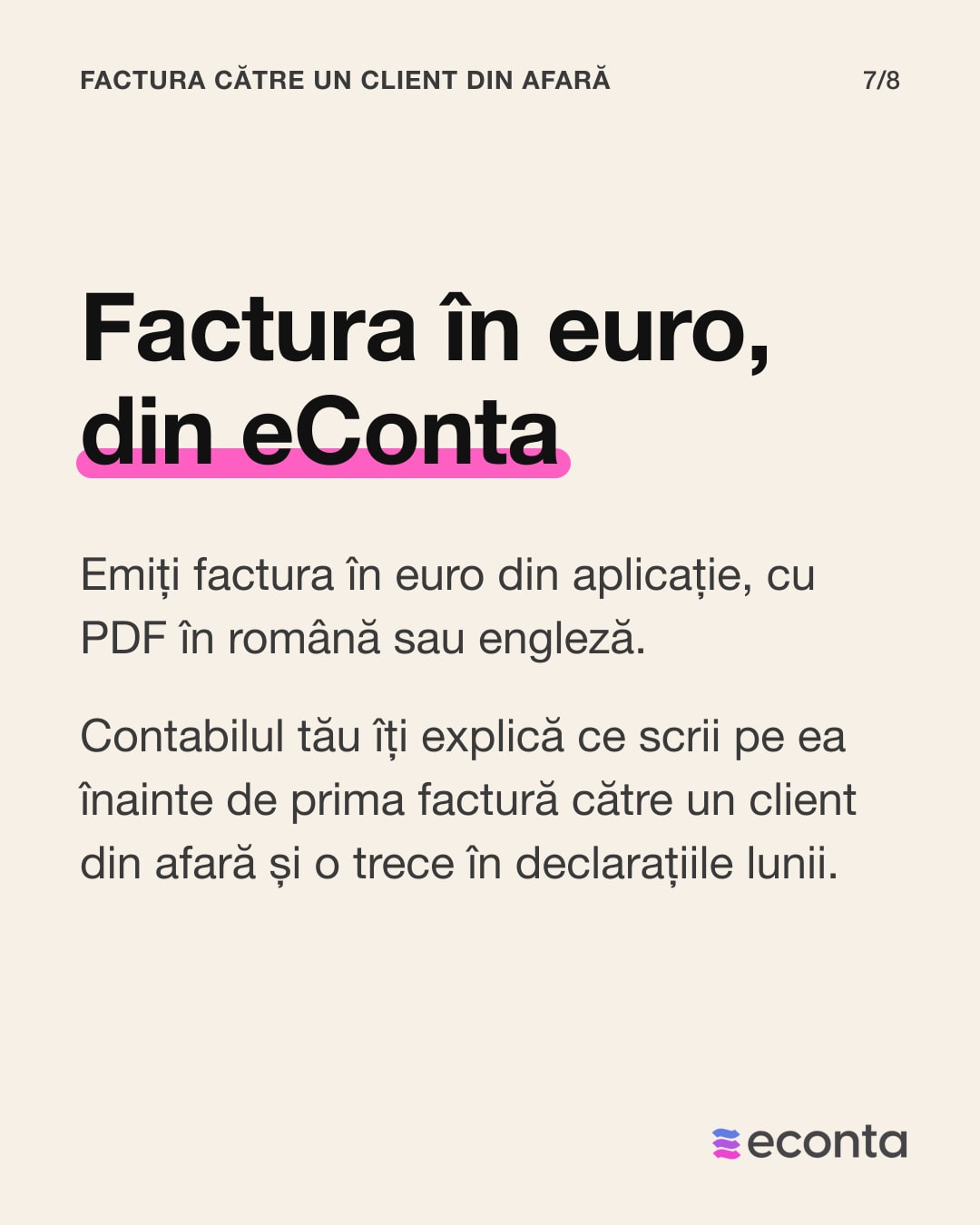
- At eConta: you issue the invoice in euro from the app, with a PDF in Romanian or English, and your accountant includes it in the monthly returns (accounting for companies and PFA).
An invoice to a foreign client without VAT is the rule for services sold to an EU company with a valid VIES number and to any company outside the EU, because the place of supply is the client’s country. The cases differ in the wording on the invoice and in the return that follows. The rules below are valid in 2026 (updated on 11 November 2026) and cover services only, not the sale of goods. For what accounting costs when you have clients abroad, see the price of online accounting.
On forums the question comes back like this: “I am a PFA (authorised natural person) and I have my first EU client. What do I write on the invoice and what do I file?” (r/RoFiscalitate2). Below: the four cases, VIES, the exchange rate, e-Factura and an example.
| Your client | VAT on the invoice | What you write on the invoice | What you file |
|---|---|---|---|
| EU company with a valid VIES number | No | “reverse charge” (“taxare inversă”), your VAT number and theirs | Form 390 the next month, plus Form 300 if you are VAT-registered |
| EU company without a valid VIES number | Checked before you invoice | Ask for the number or proof that it is a company | Depends on the proof (see below) |
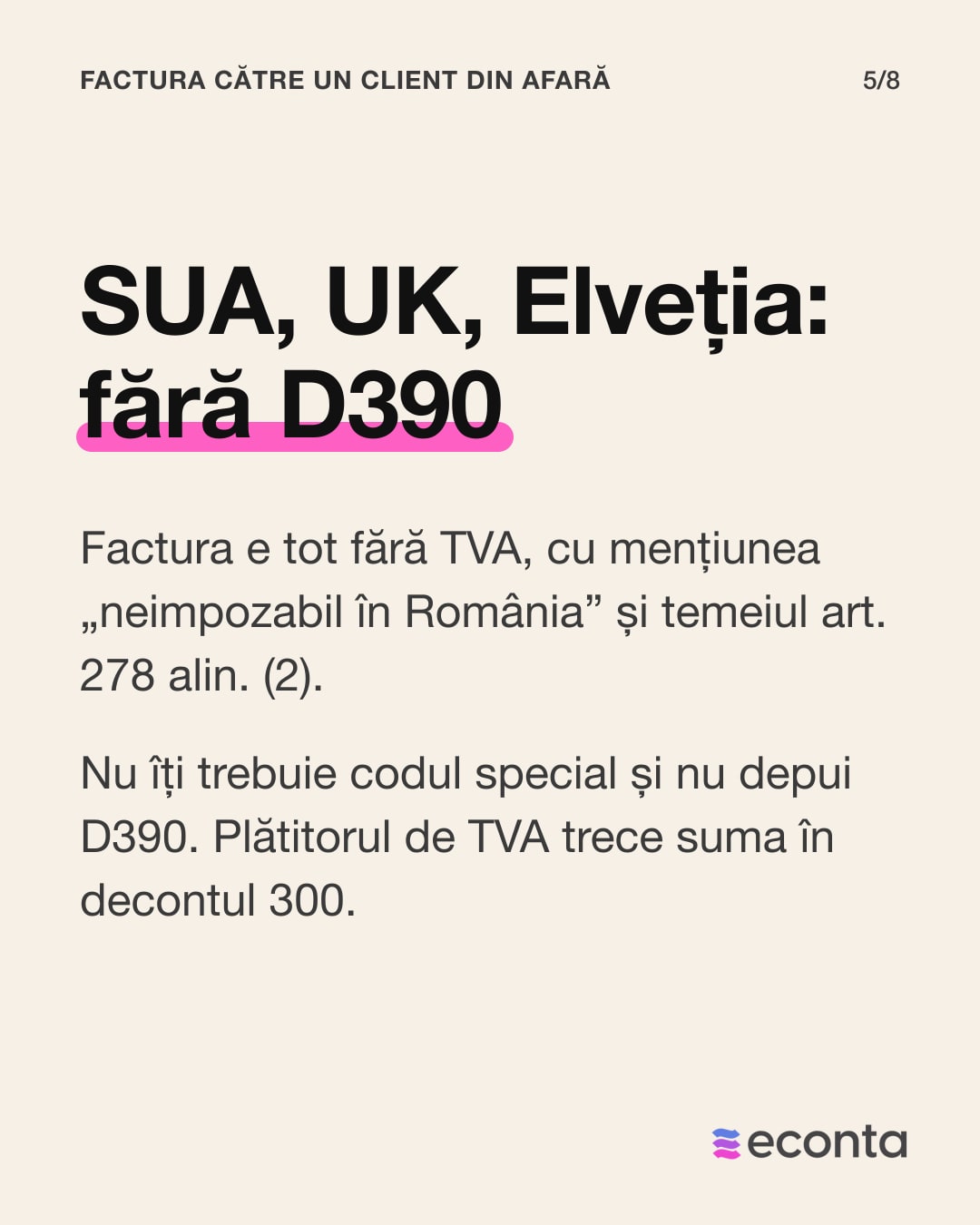
| Company outside the EU (USA, UK, Switzerland) | No | “not taxable in Romania” (“neimpozabil în România”), with the legal basis | No Form 390; if VAT-registered, you show the amount in Form 300 |
| Private individual in the EU or outside the EU | Depends on the service | Romanian VAT, or the “not taxable” wording, as the case may be | Form 300 if VAT-registered, OSS for electronic services above the threshold |
Invoice to an EU company: no VAT, with reverse charge
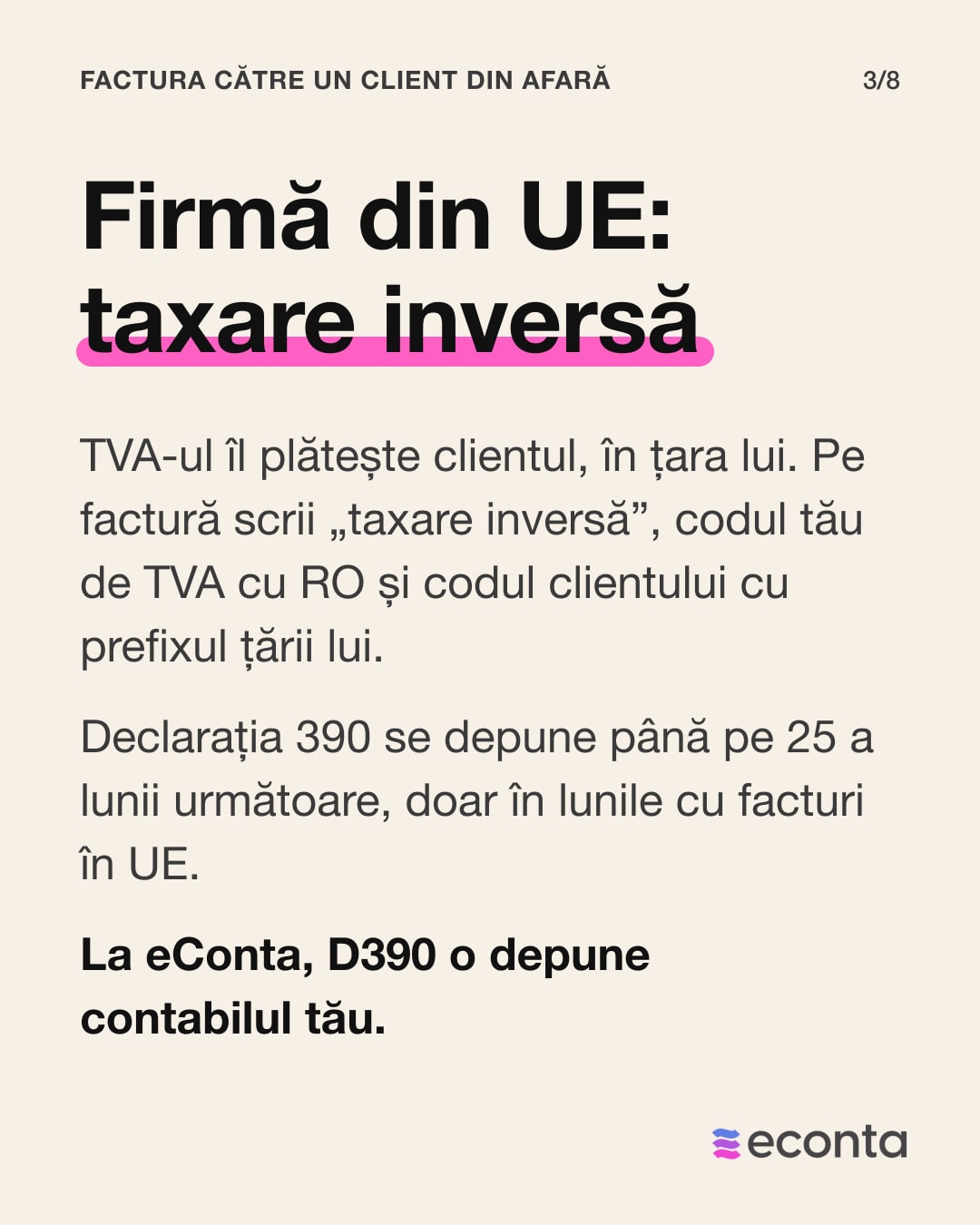
For a client that is a company in another EU state, the client pays the VAT in its own country, through the reverse charge. You issue the invoice without VAT. The invoice shows the wording “reverse charge” (“taxare inversă”), your VAT number with the RO prefix and the client’s VAT number with its country prefix (DE for Germany).
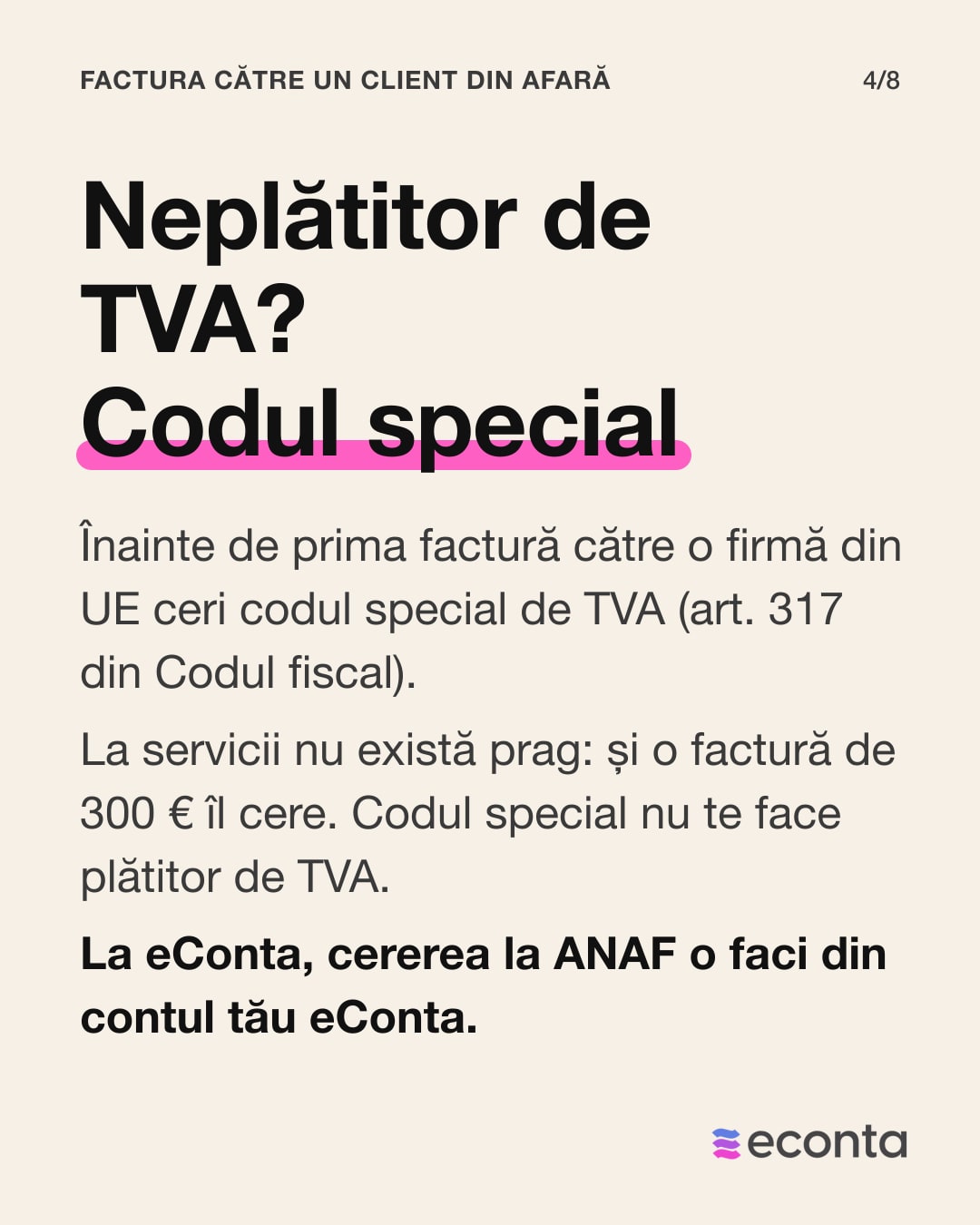
If you are not VAT-registered, your number comes from the special registration under art. 317 of the Fiscal Code. You ask for it before your first service to an EU company. For services there is no threshold above which the duty starts, so even an invoice of 300 € triggers it. You can find how to get the number, step by step, in the article about the intra-community VAT number.
After the invoice comes Form 390. You file it monthly, by the 25th of the following month, only for the months in which you invoiced in the EU. The special return, Form 301, does not apply here, because it covers purchases, not services sold.
Checking VIES: the client’s VAT number, before the first invoice
You check a VAT number in VIES for free, on the European Commission’s page, with the client’s country and number. A “valid” result is the proof that the invoice can go out without VAT. You save the result, with the date, in the client’s file.
If VIES says “invalid”, the client may have a new number, or one that is not activated for EU transactions. You ask for the correct number before you issue the invoice. Without a valid number, your accountant decides how the invoice is treated.
Client outside the EU: no VAT and no Form 390
A company in the USA, the United Kingdom or Switzerland also receives an invoice without VAT, with the wording “not taxable in Romania” (“neimpozabil în România”) and the legal basis, art. 278 par. (2). Here you do not need the special VAT number, and the invoice does not go into Form 390. A VAT-registered person shows the amount in Form 300, under the operations with the place of supply outside Romania.
Client who is a private individual: the rule changes
For private individuals, the basic rule is the supplier’s country. So a VAT-registered person invoices with Romanian VAT. A person who is not VAT-registered issues the invoice without VAT, as for any client.
The exceptions depend on the service. Electronic services (software subscriptions, recorded courses, downloads) sold to private individuals in the EU are taxed in the client’s country once they exceed 10,000 € a year, added up across all states. The VAT is declared through OSS, the EU one-stop shop. Consulting and IT services for private individuals outside the EU do not have their place of supply in Romania.
Invoice to a foreign client with VAT: when it applies
Romanian VAT appears on the invoice in three situations. You are VAT-registered and the client is a private individual (outside the exceptions above). Or the EU client has no valid number and cannot prove it is a company. Or the service has its place of supply in Romania under a special rule (for example, services linked to a property in Romania).
Invoice in foreign currency: the exchange rate and the amount in RON
The invoice can be issued in euro. For the records, the amount is converted into RON at the BNR (National Bank of Romania) rate on the invoice date. On an invoice without VAT you have no VAT to show in RON. The difference between the rate on the invoice date and the rate on the date you are paid is an exchange rate difference, which your accountant records.
Is the foreign invoice sent through SPV?
An invoice for services to a foreign company, with the place of supply outside Romania, does not have to go into RO e-Factura. From 1 January 2026, however, invoices to foreign companies registered for VAT in Romania do, for operations with the place of supply in Romania. You can find the e-Factura rules for Romanian companies on the page about e-invoicing.
Hypothetical example: the first client in Germany, 4,000 €
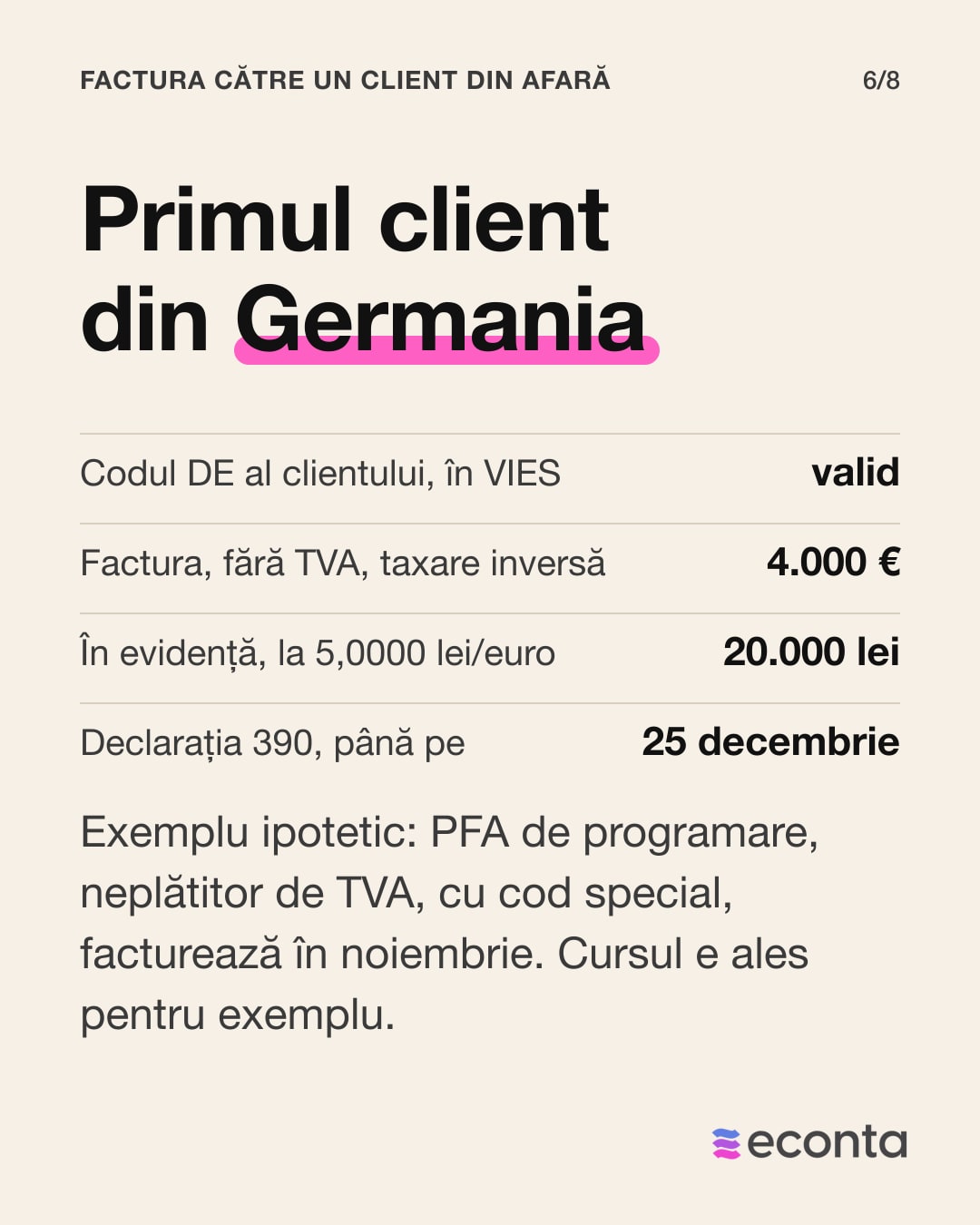
Assumptions: a programming PFA, not VAT-registered, with the special number obtained in October, invoices 4,000 € in November to a company in Germany. The rate of 5.0000 RON per euro is chosen for the example. It is not the rate of the day.
- Check the client’s number in VIES, DE plus 9 digits, and save the “valid” result.
- Issue the invoice in euro, for 4,000 €, without VAT, with your RO number, the client’s DE number and the wording “reverse charge”.
- In the records, the invoice appears as 4,000 × 5.0000 = 20,000 RON.
- By 25 December, file Form 390, with the German client, their number and 20,000 RON under services provided.
What nobody tells you
Services invoiced abroad, with the place of supply there, do not count towards the VAT exemption threshold of 395,000 RON for 2026, which counts only operations with the place of supply in Romania. A freelancer whose clients are all in the EU can invoice more than this amount and stay not VAT-registered, with the special number under art. 317. The special number does not make you VAT-registered, and full registration just for one client in Germany is a common mistake.
What to do now
- Before your first invoice to an EU company, check that you have a VAT number valid in the EU. If you do not, ask for the special number under art. 317.
- Check the client in VIES and save the result, for every new client.
- Issue the invoice without VAT, with the right wording from the table and with both numbers.
- File Form 390 by the 25th of the month after the invoice to the EU.
- For private individuals or electronic services, ask your accountant to check before the first invoice.
If you want an accountant to follow all this for you, PFA accounting starts from 39 €/month, and for an SRL from 49 €/month, with foreign currency invoices issued from the same app (PFA prices, accounting for IT companies).
Frequently asked questions
Can I issue a foreign invoice without VAT if I am a PFA who is not VAT-registered?
Yes. To a company outside the EU, you issue it with no extra formality. To an EU company you first need the special VAT number under art. 317, then you file Form 390 in the months with invoices.
Is the foreign invoice sent through SPV?
No, if it is for services to a foreign company and the place of supply is outside Romania. From 2026, invoices to foreign companies with a Romanian VAT number are sent, for operations with the place of supply in Romania.
What do I do if the VIES check of the VAT number shows “invalid”?
You do not issue the invoice without VAT until you have a valid number. You ask the client for the correct number, or for confirmation that it is active for EU transactions, then you check again.
Do foreign invoices count towards the VAT threshold?
No, not for services with the place of supply outside Romania. The threshold of 395,000 RON for 2026 counts the operations with the place of supply in Romania.
Sources
- Parliament of Romania, Law 227/2015 on the Fiscal Code, art. 278 par. (2), (3), (5) and art. 278^1 (place of supply of services), consolidated text of 31 October 2026. https://legislatie.just.ro/Public/DetaliiDocument/171282
- Fiscal Code, art. 307 par. (2) (the recipient pays VAT), art. 317 (special registration), art. 319 par. (2) and (20) (invoicing, mandatory wording), art. 324–325 (special return, recapitulative statement 390), text of 31 October 2026. https://legislatie.just.ro/Public/DetaliiDocument/171282
- Fiscal Code, art. 310 par. (1)–(2), amended by GEO 22/2025 (Official Gazette of 28 August 2025): the threshold of 395,000 RON and what counts towards turnover. https://legislatie.just.ro/Public/DetaliiDocumentAfis/301801
- Fiscal Code, art. 315 (OSS scheme) and GD 1/2016, Methodological Norms, title VII (invoicing in foreign currency and conversion at the rate of art. 290), text of 31 October 2026. https://legislatie.just.ro/Public/DetaliiDocument/171282
- Government of Romania, GEO 120/2021 on RO e-Factura, art. 10 par. (1) and (1^1), amended by GEO 89/2025; ANAF, AJFP Argeș, notice AGG_DEX-648 of 14 January 2026. https://static.anaf.ro/static/3/Ploiesti/20260115111226_comunicat%20ajfp%20arges%20-%20modificari%20ro%20e-factura%20site.pdf
- European Commission, VIES, VAT number validation (accessed 31 October 2026). https://ec.europa.eu/taxation_customs/vies/
- Real questions from forums (paraphrased):
- PFA with an EU client: what do I write on the invoice and what do I file? · r/RoFiscalitate2, January 2026
- PFA with an art. 317 VAT number and an EU client: how is the VAT threshold calculated after GEO 22/2025? · r/RoFiscalitate2, October 2026
- PFA with affiliate income from the USA: what amount do I invoice? · r/RoFiscalitate2, January 2026
A question? Write to us
How eConta helps
Related articles
-
 Tax and ANAF
PFA deductible expenses 2026: what you deduct from income and how much they cut your taxes
Which expenses a PFA on the real income system deducts in 2026, and how much they actually cut your income tax, CASS and CAS.
Updated: 11 November 2026 · 16 min read -
 Tax and ANAF
SAF-T (Form D406) return: a legal obligation and a responsible approach
At eConta, SAF-T costs 15 €, and the checking is included. Your peace of mind too.
Updated: 9 July 2025 · 5 min read -
 Tax and ANAF
The tax regime for micro-enterprise income tax
This article explains the tax regime for micro-enterprises in Romania, including the eligibility conditions, the rates of…
Updated: 24 February 2025 · 6 min read